The spare3 variable only counts up/down after synch is achieved and is only meant to maintain synch when you have occasional noise/ dropped pulses.
What I see happening, based on the top picture in your scope shot, is what you call ripple, where the VR waveform actually rises for a sort bit, enough to cause a false zero crossing and hence a square pulse, before plunging down. This happened in at least 3 places in the picture, causing 3 false triggers. It would seem that the best way to get rid of it would be to raise the threshold for zero crossing, but this isn't easy with microsquirt. Playing with the teeth is also a possibility. What are the 20 magnets for ? can they be removed if you think they are causing the ripple ? This isn't something to fix in software, at least not something easy.
Another dropped cranking RPM
Forum rules
Read the manual to see if your question is answered there before posting. If you have questions about MS1/Extra or MS2/Extra or other non-B&G code configuration or tuning, please post them at http://www.msextra.com The full forum rules are here: Forum Rules, be sure to read them all regularly.
Read the manual to see if your question is answered there before posting. If you have questions about MS1/Extra or MS2/Extra or other non-B&G code configuration or tuning, please post them at http://www.msextra.com The full forum rules are here: Forum Rules, be sure to read them all regularly.
I realized the false teeth issue, and have marked up a scope image with the problem. Blue lines are real teeth, red lines are erroneous.
I suspected it was beyond the scope of simple configuration changes.
I am leaning towards the VR circuit modifications, as I cannot imagine a simple way of cleaning up the wheel.
The magnets in question are the alternator for my engine. As I need to recharge my battery it cannot be removed. My math surrounding the alternator was flawed however, there are 20 magnets, but they alternator polarity, so the pattern would repeat every 6teeth or half rotation, but this is still not consistent with the scope.
In a few hours I will recording the waveform for all conceivable rpms, and determining nice trigger and reset levels.
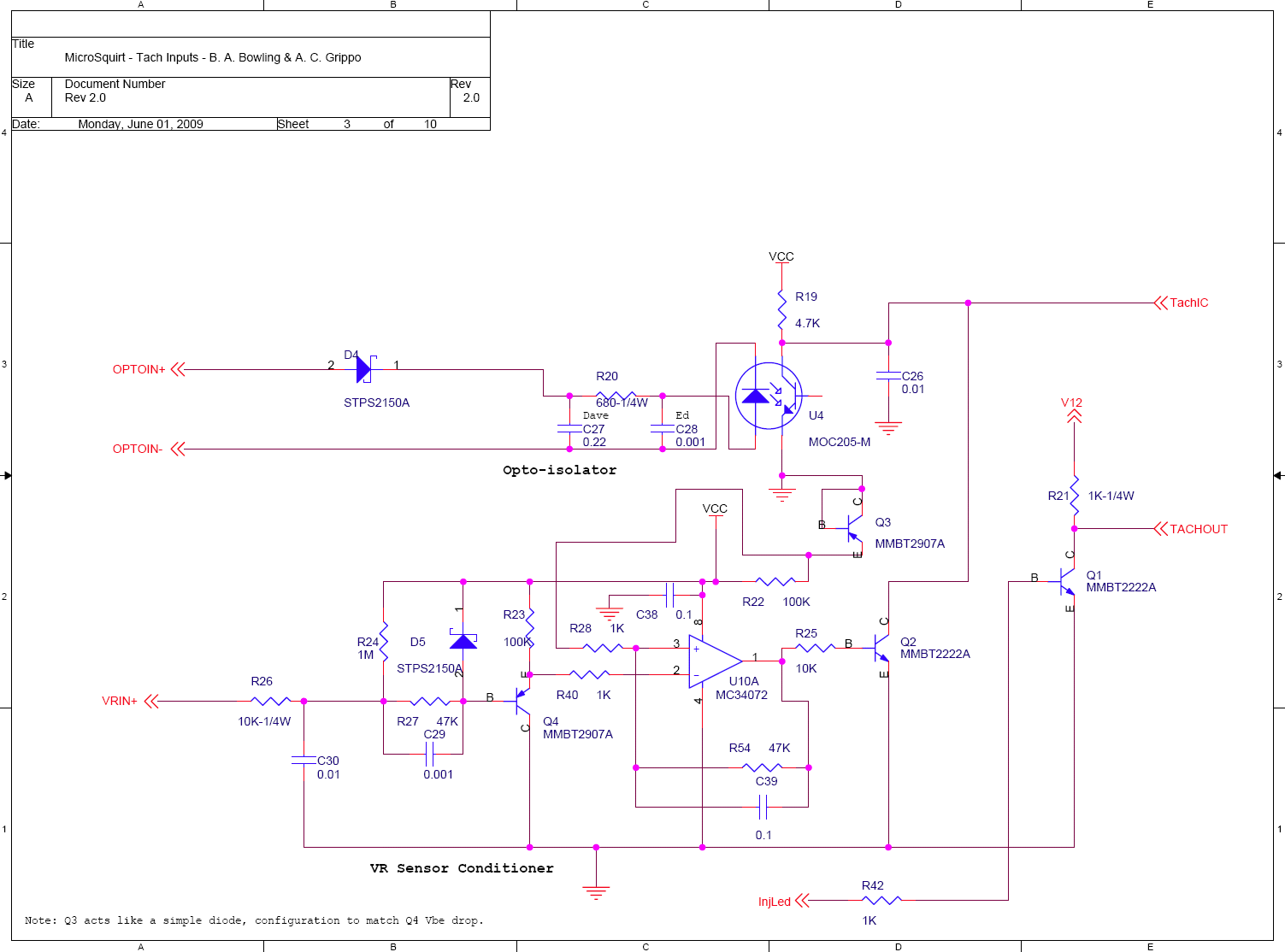
I am also looking at the schematics, but my knowledge of op amp theory is somewhat faded. If I am reading correctly I could replace R54 and R22 to adjust the levels, but then I am confused about the need for R28 and Q3.
Once I have my desired voltages, could someone help me in verifying my resistor choices. Did I see a post somewhere with a simulation of the VR circuit?
Thanks
Geoff
I suspected it was beyond the scope of simple configuration changes.
I am leaning towards the VR circuit modifications, as I cannot imagine a simple way of cleaning up the wheel.
The magnets in question are the alternator for my engine. As I need to recharge my battery it cannot be removed. My math surrounding the alternator was flawed however, there are 20 magnets, but they alternator polarity, so the pattern would repeat every 6teeth or half rotation, but this is still not consistent with the scope.
In a few hours I will recording the waveform for all conceivable rpms, and determining nice trigger and reset levels.
I am also looking at the schematics, but my knowledge of op amp theory is somewhat faded. If I am reading correctly I could replace R54 and R22 to adjust the levels, but then I am confused about the need for R28 and Q3.
Once I have my desired voltages, could someone help me in verifying my resistor choices. Did I see a post somewhere with a simulation of the VR circuit?
Thanks
Geoff
- Attachments
-
- Timing issue.JPG
- (117.66 KiB) Downloaded 14 times
I have now watched the scope from idle to 12krpm and have watched the "ripple", it becomes more pronounced during the 4-7k range where I was loosing tach before. I have seen it as been as high as about 1V, but it was hard to read as it was hard to get a scope trigger.
I should note that the stock ecu was connected during this test, and it has some signal conditioning, atleast statically it adds 40mV to Vr1+.
I was also wondering if I could do some sort of a pull up voltage on Vr1+. If I brought the level up 1V, then the reset would not be triggered and the ripple would be ignored. It would have to be isolated to prevent adding noise to the supply.
I should note that the stock ecu was connected during this test, and it has some signal conditioning, atleast statically it adds 40mV to Vr1+.
I was also wondering if I could do some sort of a pull up voltage on Vr1+. If I brought the level up 1V, then the reset would not be triggered and the ripple would be ignored. It would have to be isolated to prevent adding noise to the supply.
-
Bruce Bowling
- Site Admin
- Posts: 285
- Joined: Mon Feb 16, 2004 4:25 pm
- Location: Baltimore, MD
OK - you and "Old Guy" appear to have harnesses with an error. As pointed out, the shield should be on VR- and the center conductor should be on VR+ terminal.geoffct wrote: I have verified again, the polarity shield to be the ground wire as the center of the coax, and the signal to be on the shield. As people have mentioned this seems somewhat atypical. This wire is run to a stock connector where the connector is run over unshielded parallel wires.
I have the harnesses made up by a contract manufacturer. On the first go-around, the harnesses were made up proper w.r.t. shield and center conductor. However, the second batch made up appears to have the two reversed. It took us awhile for figure this out. We test each and every MicroSquirt to make sure it operates. But the harness is just a visual, and with the heat shrink on the connector end it is hard to see.
If you want, I can fix the harness for you (email me offline at bbowling@earthlink.net). You can also easily fix the connector yourself, it takes 3 minutes to do. All you have to do is pull off the red clip on the harness connector, this will expose all of the pins. Next, find the two pins for the coax shield and center conductor and *gently* wiggle them while gently pushing the terminal - it will dislodge and push back. then switch the locations and push back in till it clicks in place. Then reinstall the red clip (line up all of the terminals).
For your case here I am not convinced it will help. As you point out, there is a return to zero blip that is probably causing a false reading. This is most likely due to the VR pole tip not being the same size as the teeth on the crankwheel. There also appears to be some runout on the wheel (from the amplitude modulation), but this should not affect anything.
Here's what you can try - grab a diode, like a 1n4001. When this conducts it will drop about 0.6 volts. Put this in series with the VR+ lead from the VR sensor. Put the diode band towards the VR+ MicroSquirt input. It appears there is just enough voltage during cranking to overcome the 0.6V drop of the diode.
- Bruce
-
Bruce Bowling
- Site Admin
- Posts: 285
- Joined: Mon Feb 16, 2004 4:25 pm
- Location: Baltimore, MD
*** OK ***
Before you do any of the items I posted above (harness correction or diode), I want you to do the following:
1) Swap the VR wires on the sensor
2) Change the input capture setting in MegaTune from "rising edge" to "falling edge" (or the opposite of whatever you have it set to.
Here's why: the VR circuit has a hysteresis setup where the signal has to go past zero volts to about -150mv before it resets for a positive transition of about +60mv. The extra blip on the scope shot, where the input signal goes below zero then nips back to zero, is simply resetting the hysteresis.
So, by reversing the VR wires you a inverting the signal, the negative-to-nearzero blip becomes a positive-to-nearzero blip, which is a bit outside of the hysteresis point.
Try this first and see if there is any improvement...
- Bruce
Then, by telling the software to look for the falling edge instead of the rising edge, this "undoes" the inversion.
Before you do any of the items I posted above (harness correction or diode), I want you to do the following:
1) Swap the VR wires on the sensor
2) Change the input capture setting in MegaTune from "rising edge" to "falling edge" (or the opposite of whatever you have it set to.
Here's why: the VR circuit has a hysteresis setup where the signal has to go past zero volts to about -150mv before it resets for a positive transition of about +60mv. The extra blip on the scope shot, where the input signal goes below zero then nips back to zero, is simply resetting the hysteresis.
So, by reversing the VR wires you a inverting the signal, the negative-to-nearzero blip becomes a positive-to-nearzero blip, which is a bit outside of the hysteresis point.
Try this first and see if there is any improvement...
- Bruce
Then, by telling the software to look for the falling edge instead of the rising edge, this "undoes" the inversion.
Thanks,
Don't worry about the shield wiring, I may have inadvertently swapped them to being incorrect in the first place. I removed a number of pins while making my harness, and then replaced them following one of the early revisions of the wiring documentation. I do recall asking myself about the shield not being ground, and should have posted the question then.
I have tried all four possibilities of wiring and software polarity, without success, but I wasn't watching q2's output when I was doing that, merely watching megatune. Regardless I will try again this afternoon.
I will also try the diode, but how will I get a low enough level to reset the hysteresis?
Thanks Again,
Geoff
Don't worry about the shield wiring, I may have inadvertently swapped them to being incorrect in the first place. I removed a number of pins while making my harness, and then replaced them following one of the early revisions of the wiring documentation. I do recall asking myself about the shield not being ground, and should have posted the question then.
I have tried all four possibilities of wiring and software polarity, without success, but I wasn't watching q2's output when I was doing that, merely watching megatune. Regardless I will try again this afternoon.
I will also try the diode, but how will I get a low enough level to reset the hysteresis?
Thanks Again,
Geoff
-
Bruce Bowling
- Site Admin
- Posts: 285
- Joined: Mon Feb 16, 2004 4:25 pm
- Location: Baltimore, MD
You won't - thats why this was a rather dumb suggestion on my part to try.geoffct wrote: I will also try the diode, but how will I get a low enough level to reset the hysteresis?
With more "thinking" time on this, what would help would be to raise the potential on the return lead of the VR sensor (the one going to VR-) - this would effectively raise the whole waveform up a bit.
Try the following (maybe I should try as well, after the diode suggestion): make a voltage divider between the Vref (at 5 volts) and the VR- terminal on uS. Use a 1K resistor to Vref, and a 100 ohm resistor to VR-, and tie the two free resistor ends together and to the return VR wire. The voltage at the junction of the two resistors is 5V*(100/(1000+100)) = ~0.45 volts. I do not believe there will be enough current feeding back to Vref from the VR sensor (even at high speeds) to cause the regulator to go out of regulation.
- Bruce
I swapped vr sensor wires, and I am having limited success. I still lose RPMs from 4k-7k. I am however able to start and run at idle.
Also I know there's a noise issue, because I only get starting rpms with the stock starter switch, this is how I lost starting RPMs a couple of months ago or so I believe. I expect to be able to clean up the other switch with a diode.
I will probably still need to condition the VR signal a bit, so I will post a scope of VR+ and Q2 at 4-7krpm later.
Thanks Again,
Geoff
Also I know there's a noise issue, because I only get starting rpms with the stock starter switch, this is how I lost starting RPMs a couple of months ago or so I believe. I expect to be able to clean up the other switch with a diode.
I will probably still need to condition the VR signal a bit, so I will post a scope of VR+ and Q2 at 4-7krpm later.
Thanks Again,
Geoff
-
Bruce Bowling
- Site Admin
- Posts: 285
- Joined: Mon Feb 16, 2004 4:25 pm
- Location: Baltimore, MD
Another thing is to add series resistance to the VR+ lead, say 4.7 to 10K or so.geoffct wrote:I swapped vr sensor wires, and I am having limited success. I still lose RPMs from 4k-7k. I am however able to start and run at idle.
Also I know there's a noise issue, because I only get starting rpms with the stock starter switch, this is how I lost starting RPMs a couple of months ago or so I believe. I expect to be able to clean up the other switch with a diode.
I will probably still need to condition the VR signal a bit, so I will post a scope of VR+ and Q2 at 4-7krpm later.
Thanks Again,
Geoff
If you are good at SMD rework, it may really help to change the hysteresis resistor that is on the opamp (the 100K one going from the output back to one of the inputs). Lower this to 47K or so, this will increase the hysteresis amount to roughly -0.3V
- Bruce
Thanks for the tips Bruce, I think I may simply replace that 100k with 47k. One of the team members does smd rework everyday, so swapping resistors is nothing at all. Could we go lower than 47k ohm?
Also could you verify which resistor I need to replace on this diagram? I thought you were referring to R54, but that is already listed as 47k. Are these the latest schematics?
Thanks Again,
Geoff
Also could you verify which resistor I need to replace on this diagram? I thought you were referring to R54, but that is already listed as 47k. Are these the latest schematics?
Thanks Again,
Geoff